I was born in San Francisco, in 1971, to hippie parents. I've often wondered what it would be like to grow up in an inner city. I’ve been in a lot of what people call “bad” neighborhoods, but I didn’t grow up in a large city. I definitely lived in ‘projects’ though.
Maybe I was 1 and this is the only photo of us all together
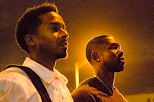
My mom and I moved to Marin county after my parents split. I think I was 2. We lived in pretty extreme poverty. My dad disappeared. Trying to survive when I was little was no joke. There were always lots of drugs laying around our house. People came and went a lot. I used to throw away needles, bags of cocaine, and grew up way faster than any kid should have. I remember being very angry about that at a young age. I would tell my mom at 5 years old that "people don’t act right when they take drugs." I was an isolated kid. I went to 8 different schools growing up and always felt like an outcast. To say I related to to the main character of Moonlight is an understatement. I saw myself as a child in him, and I wanted to hug us both. I was angry at his mother as if she were mine.
"Little," feeling as if he doesn't belong - The camera movement when they wrestle makes you feel like you are wrestling with them. The shaky, hand-held movement, with zooms and closeups puts you in the action.
I couldn't help but feel like I was walking along with Chiron through the whole film, intimately; like I was growing up with him. I ached for him as a small boy, craving the love of his mother, friends, companionship altogether. Wishing she would get her shit together so he wasn't so alone, but knowing that she wasn't going to. At such a young age already wondering why he's not like everyone else; already feeling like he doesn't belong. He built walls. The camera showed us this. So often in this film, the director of photography uses a first-person-point-of-view to force us to see (and feel) what Chiron was.
"Little" despondent that his mom can't get it together. Many of the scenes where Chiron has peace are hued in blue but when he's at home we see reds, auburn's oranges and pinks. Much warmer colors that convey the hotness of his situation.
Through the three phases of Chiron's life, I was bound to his story. Feeling like I was part of his daily life was gifted masterfully by D.P. James Laxton (also born in San Francisco). His use of unconventional framing, movement, and closeups are a big part of the reason that many of us who watch this film feel like we are right next to Chiron the whole time. The camera always brings us right into the action. My favorite scene from the film is when Juan, whose impeccable performance by Mahershala Ali wins an academy award, teaches Chiron to swim. The camera sits a bit above the water but also just below the water line. You are swimming with them. It’s the first time Chiron has peace. When you grow up being tortured, you remember those moments of tranquility deeply. They are just so rare.
Juan teaching Chiron to swim and you are in the water with them
In the final Act of Moonlight we see that Chiron now calls himself "Black" after a stint in prison. Although I never did prison time (I didn’t say I hadn’t been arrested), I sure went through a rebellious phase and got into a lot of trouble. Getting knocked up, instead of locked up is what saved me. I yearned for Black's happiness in the same way I yearned for my own in my 20's. He deserved it. He'd put up with enough. He built an emotional suit of armor along with his 20 inch biceps and it seemed impossible that anyone could hurt him any more. He had finally come into his own.
The color palette of most of the last act is filled with warmer tones when Black returns to Miami. This kept me curious about a potential happy ending. Most of the red/hot pink/orange scenes from earlier in the film were negative for Chiron. A subtle clue that Chiron had changed his destiny.
In the end, after deeply understanding the hurt and pain "Little" had gone through as a child, after clenching from the torture of Chiron dealing with his drug addicted mother, and wincing at the thought of how Black was certainly tormented in prison, Chiron finally gets the hug I was desperate to give him the entire film. And I felt it.
Chiron meets Kevin after years apart and they share an embrace, followed by what I construe as a memory of Black saying goodby to the tortured "Little" boy within him.
I loved the slower pace of this movie. It felt like real life. We've grown so accustomed to the blockbuster that we don't have a penchant for anything that doesn't explode. There is also no doubt that some viewers will feel homophobic discomfort that is entrenched throughout the film and in Chiron’s hatred of self. I make no apologies for this. It’s time we stop letting society destroy people because they don’t understand them. It’s called empathy...we can all do better.
CHIRON’S STORY IS MEANT TO TEACH THIS AS WELL!
Film is often an artistic representation of real life. For me, this particular interpretation of survival really struck a cord, as it obviously did for many others by the high accolades it received.
And thank you Barry Jenkins for letting me be in this movie.
My little self thanks you too<3
I definitely give this film 5 hearts but they are Blue to match the Hue of Moonlight :) 💙💙💙💙💙
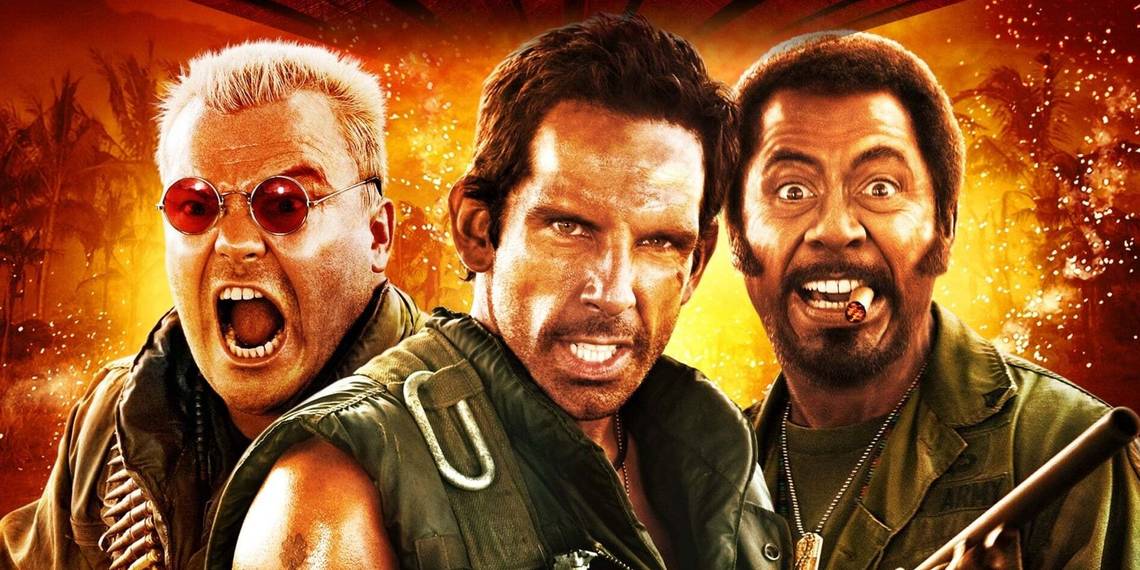
Jack Black, Ben Stiller (Director, 2008), and Robert Downey Jr. from Tropic Thunder Poster
Tropic Thunder is a movie about making a movie, where a group of ego-driven actors join forces in a farcical, yet real, war film. Think a satire of The Expendables (dir. Stallone, 2010), which may be where Stallone got the idea for his franchise. Part of the allure of Tropic Thunder is Stiller's uncanny knack at using irony to point out our own personal flaws. If you laugh at the method acting, black-faced Downey Jr, or the horrible acting that embodies Simple Jack, then you are flawed, because those are off limits by societal decision.
Simple Jack trailer as seen in the film Tropic Thunder
Making fun of race, ability, sexuality, religion, or any other sensitive issue should be prohibited to some. I would argue that without satire, we never understand where those limits are, or when they are being abused. Comedy is the SAFEST place to test this! We've all been in serious, heated discussions. They don't go over as well as a good action comedy.
Last week Ben Stiller brought this film back onto the radar with the following tweet:
I'd like to say there are two camps to this debate; those of us that are free speech purists, and those that get butt-hurt easily. Okay, so that's rude, but understanding the subjectivity of film viewing tells us there are millions of impressions of this movie. There are certainly a wide-range of opinions as to whether Tropic Thunder is offensive or not.
Robert Downey Jr in Blackface using the word "retard."
Just two of the controversial issues broached in Tropic Thunder
Still, just because I find THIS satirical approach to blackface funny (I don't think all blackface is funny), I don't find joy in the hurt feelings of others. It's funny because it's SO wrong. It's shocking and then Downey Jr. played it to a tee. He employed every stereotypical, tropey aspect of method acting, ACTING like he was good enough to pull it off... lot of layers to that character actually. He was nominated for an Oscar, so the Academy acknowledged this. For me, this is the whole reason I agree with Stiller, he should not apologize. Can comedy go too far? I can only answer for me, and yes, there are times I have found comedic representations offensive. In this case, the portrayal pointed out the absurdity. As much as I hate the word "retard," the Simple Jack scenes would have fallen short without it and would have been less absurd, ensuring some would miss the point. Whether it's right or offensive or stupid, I still don't think it should be brought to its knees by "Cancel Culture."
The best outcome from any of this is a cultural discussion about meanings and intent. Even better, make us really think about the Les Grossman character that is a total asshole and preys on others. I'm sorry that it took almost a decade after Tropic Thunder to actually catch up to Harvey Weinstein.
Tropic Thunder is comedic satire, which doesn't inherently protect it from controversy, but it sure opens the door to parody a lot of ridiculous aspects of the film industry. Would we accept an expose on the extreme egos of actors and the lines they may cross to remain famous? Well, they exist! It's a fact that documentary isn't going to draw the same audience as an action flick. Like the gawkers that hold up traffic staring at an accident, we would rather be shocked then simply informed. Tropic Thunder does this to make us ask, how far is too far? How ridiculous is too ridiculous? I mean, there's a movie called Cocaine Bear coming out next week! We will hear from animal rights activists. It will gross millions.
INTENT MATTERS! In their own words, hundreds of times, Ben Stiller, Justin Theroux, and Etan Cohen have said they are proud of the film and the issues it raised. It was intentional and entertaining! That's exactly what I want from my art. They were asking us to think about how we value celebrity. We ARE the consumers of superstardom. We crave unique, thought provoking performances that are Oscar worthy. We want to see our favorite stars pushing boundaries and giving us something we've never seen before. We will stop buying tickets or streaming if we aren't impressed. And as I've just had 23 out of 24 students tell me Citizen Kane is quite assuredly NOT the greatest movie of all time, audiences are changing. That's what I think Tropic Thunder was asking and telling us at the same time. At the absolute heart it was a funny action movie, as it was intended, with some scenes that would even make Michael Bay proud.
Moviefone Interview
To be media literate is to understand the mediums you are consuming. Tropic Thunder is a piece of art entertainment that sought out to enthrall a contemporary audience while making them laugh. Maybe 15 years ago audiences were different than the current one that won't blockbust anything other than Superhero movies.
To understand Tropic Thunder's intentions means you understand this film was trying to show you a line, and then like all good comedy, they attempted to push past it to make a point. It worked for me.
I give this film 💜💜💜💜💔 4 purple hearts and broken heart for anyone who was really hurt by it.
This iconic scene; when we see young Charles truly happy for arguably the last time. The scene that sets up a life time of accumulation trying to fill the void that came from lack of family and love. Charles Foster Kane was happy sliding down that hill. We never see him filled with that kind of joy again. The age old question of whether money can buy happiness is answered. No, it certainly can not, nor can it buy love. As young Charles slides down the hill almost coming through the window, the audience sees the ultimate decision taking place that will change the trajectory of his life forever. Both parts of this scene equally important: Seeing Charles happy and the torturous decision his parents are making. Equally important and equally visible is everything in the entire frame of the shot. Without a split screen, the viewer is watching two actions happening at once, one in the background the other in the fore. It's one of the first times we see the deep focus technique that will change the way directors move through scenes in movies from that point forward.
Examples of Deep Focus
For taking one of the oldest adage's in story telling and making it brilliantly different, I believe Citizen Kane (Dir. 1941 Welles) is still the most remarkable film. Thesyuzhitnarrative is vital to Kane's reception by the audience. Because the reporter uncovers the information out of chronological order, our emotions bounce all over the place. The pity evoked at the same time many feel true disdain for Kane, is awesome, and due to this narrative technique. I can't imagine character emotions before Kane ever dripping off the screen the way they did in Kane. The narrative and camera told us how to feel. The combined techniques amplified their individual effects.
Viewers can feel the dissolution of the Kane marriage through camera work
Twisting this antiheroic love story on its side is not the only reason Kane should still be considered the greatest movie ever. For the first time in film history, cinematography proved a 2-dimensional medium could FEEL 3-dimensional. Director of Photography, Gregg Toland was a genius behind the camera and he understood lenses as a science. It was also his humble, quiet teaching after production hours that allowed Welles to take credit for the masterpiece that became the greatest. Every single shot in the movie is a masterpiece, as if it were orchestrated like notes in a symphony. It proves cinema is undeniably an art form that uses many nuanced techniques to achieve its messaging.
Finally, the cajones of Welles himself, to go after the greatest Tycoon of his time in spoofing the life of William Randolph Hearst, cracks me up every time I think of it. Hearst attempted to black list Welles for the film. Not necessarily well received at the box office, Hearst made sure only bad or no reviews made it into his monopoly of newspapers. Still, it was nominated for nine academy awards only to win one for best screen play. Was Hearst's sentiment influential within an academy that depended on his papers for press? The preeminance in Kane was obvious. How could it not win more, best cinematography at the least? It wasn't until Kane aired on television in the 50's that film scholars and critics began to look at the movie through a deeper more analytic lens. Its true influence was chronicled.
Comedy Central ~ Drunk History on Hearst & Welles :)
Many students ask me if I've been brainwashed to think Kane is the best because industry leaders have been saying it for so long. Haven't I seen Avengers!!!? It's a great question and my response is perhaps argumentum ad populumis taking place. Still, just saying it doesn't make the cinematography awesome, it truly is incredible for anyone to see, even by today's standards.
Like I respect Mohammad Ali as the best, Alice Paul or Sandra Day O'Connor as original badasses, others may not agree. There are definitely better movies than those made by Alice Guy Blache, 100 years ago, but it is her firstness, plus greatness, and almost perfection, that combine to equal 'the best.' In an age where GOAT's are determined precisely, statistically, and change often, being perfectly awesome and first is a better calculator for me. There's a bravery in it, that those who follow don't have to have. That is part of the reason I say Citizen Kane is the best. For the first time in cinema history all of the stars aligned; a daring, innovative narrative, jaw-dropping cinematography, masterful editing, gorgeous and disturbing chiaroscuro lighting, and uncanny acting performances that you really believed, all came together like a strike of lightning. I respect Kane's position as the first of the thousands of films that would try to emulate its excellence. Many have come close to matching the greatness of Kane, some have surpassed it in ways, but none have matched the synergy of mastering all the amazing cinematic techniques and innovations that made up the 1941 classic.
Chiaroscura in Kane
Students also ask me 'if I think it's the best, shouldn't it be my favorite movie'? I don't think so. Whether it's my favorite doesn't change that Citizen Kane was the first to do so much right in one film. Like many other mediums, technologies, or historical advancements, it gets to keep the title of 'best' for its historical significance as well as its prodigiousness. That's the reason I feel passionately that film students should see this movie and understand what it did, is, and does, even if some are bored by it. My job is to help you see the significance. I DO love Avengers! I hope my students can see there are aspects of Avengers that wouldn't exist without Kane.
And whether it's my favorite or not, if I'm rolling through the channels on the TV (if we actually do that anymore) and Citizen Kane does happen to be on, you can bet I'm stopping and quit assuredly seeing something I've never caught before. And I've seen it dozens of times. The ONLY other movie I can say that about is Airplane:) I'm pretty certain the Zucker brothers took a page out of the Kane playbook for their scenic design, which is exactly the point I'm making. Kane is the greatest until another film break's every boundary in cinema history, all in one feature...then thousands of films copy and millions of people talk about it for decades and decades after its release.
I give this film: 💜💜💜💜💜 Five Purple Hearts out of Five Purple Hearts!